
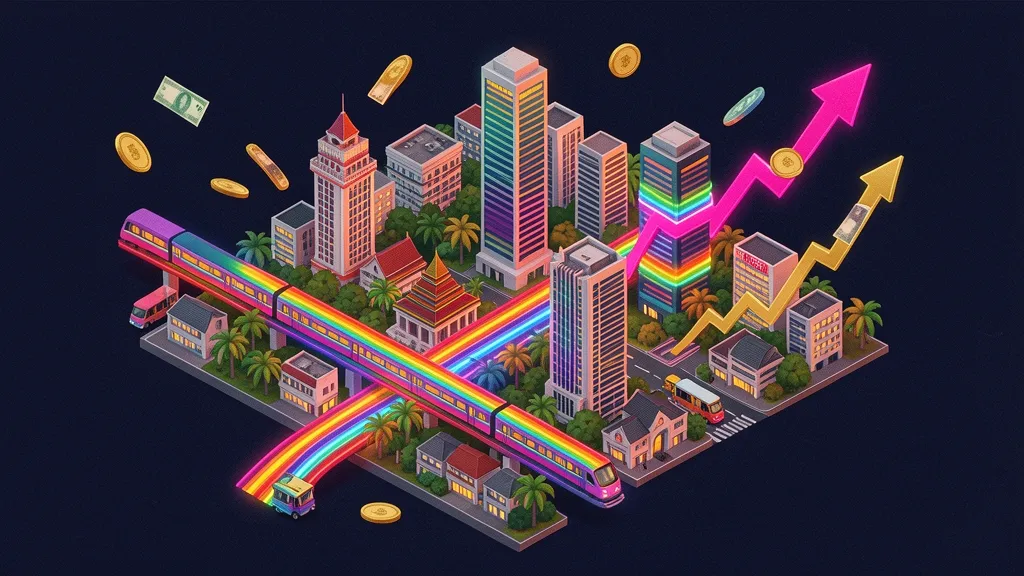
Key Takeaways
- ✓Thailand's Pink Economy is valued at approximately THB 210 billion in 2026 and projected to reach THB 350 billion by 2030, driven by marriage equality legislation and rising corporate engagement.
- ✓Tourism accounts for 40% of the total market, but financial services (20%) and health and wellness (15%) are the fastest-growing segments.
- ✓Only 4 of 87 tracked SET-listed companies currently achieve Platinum-tier LGBTQ+ ESG ratings, representing a significant gap and opportunity for corporate Thailand.
- ✓The LGBTBE certification pipeline has surpassed 100 Thai businesses, unlocking supply-chain access to multinationals with supplier-diversity mandates.
- ✓PrideShow 2026 at BITEC Bangna (June 26-27) will convene 200+ exhibitors across all five segments of the ecosystem for the first dedicated Pink Economy trade event in Southeast Asia.
When Thailand made history on 22 January 2025 by becoming the first country in Southeast Asia to legalise same-sex marriage, it did more than advance civil rights. It fired a starting gun on one of the region's most compelling economic narratives: the maturation of a domestic Pink Economy that now touches every industry vertical from banking and insurance to hospitality, retail, real estate, and digital media. This guide unpacks the numbers, maps the ecosystem, and lays out the investment case for stakeholders who want to move beyond rainbow-washing into measurable, profitable inclusion.
This is not a niche story. The global LGBTQ+ consumer market was valued at USD 4.7 trillion in 2023 by LGBT Capital, and Southeast Asia's share is accelerating faster than any other sub-region. Thailand sits at the epicentre of that growth, combining legal reform, cultural openness, a world-class tourism infrastructure, and a government explicitly targeting "soft power" exports. The Pink Economy is no longer an afterthought appended to corporate social responsibility reports; it is a structural economic shift that demands a dedicated analytical framework.
How we define "Pink Economy"
Throughout this guide, "Pink Economy" refers to the aggregate economic activity generated by LGBTQ+ consumers, businesses, employees, and allied organisations, plus the corporate, governmental, and non-profit infrastructure that serves them. It encompasses direct spending, employment multipliers, investment flows, and the policy frameworks that enable or constrain them.
What Is the Pink Economy? Definition and Global Context
The term "Pink Economy" (sometimes called the "Pink Dollar," "Pink Pound," or "Rainbow Economy") describes the economic ecosystem surrounding LGBTQ+ communities worldwide. Coined in the marketing literature of the 1990s to describe the spending power of gay men in Western urban centres, the concept has broadened dramatically over three decades. Today it encompasses an interlocking network of consumer markets, business ownership, employment dynamics, investment vehicles, tourism flows, healthcare systems, media and entertainment, and the regulatory architecture that shapes them all.
Globally, the LGBTQ+ community is estimated at 500 million to 600 million people, with aggregate annual spending power exceeding USD 4.7 trillion according to LGBT Capital's 2023 index. That figure places the community's GDP-equivalent between Switzerland and Japan. Yet the economic conversation has historically been dominated by North American and Western European data. Asia-Pacific, home to roughly 60% of the world's LGBTQ+ population by most demographic models, has been dramatically under-indexed in research, policy design, and corporate strategy.
USD 4.7T
Global LGBTQ+ spending power (2023)
LGBT Capital estimate, equivalent to the GDP of the world's third-largest economy
Three structural forces are reshaping the Pink Economy in the mid-2020s. First, legal reform: marriage equality, anti-discrimination statutes, and gender recognition laws have spread rapidly, now covering markets representing over 70% of global GDP. Second, corporate accountability frameworks including ESG reporting standards such as GRI 405 (Diversity and Equal Opportunity) and the EU Corporate Sustainability Due Diligence Directive (CSDDD) are forcing companies to quantify inclusion rather than merely profess it. Third, digital platforms have collapsed geographic barriers, enabling LGBTQ+-owned micro-enterprises to access global supply chains and consumer bases with minimal capital requirements.
Thailand occupies a unique position within this matrix. Its cultural tolerance is frequently cited but rarely quantified. Its legal framework, since January 2025, is the most progressive in ASEAN. Its tourism infrastructure is among the most developed in Asia. And its capital markets, anchored by the Stock Exchange of Thailand (SET), increasingly face scrutiny from international institutional investors who integrate LGBTQ+ inclusion into ESG scoring models. The confluence of these factors makes Thailand the natural laboratory for the region's Pink Economy thesis.
Thailand's Pink Economy by the Numbers
Estimating the size of any identity-driven economy involves methodological challenges, from self-identification rates to the boundary between "LGBTQ+ spending" and general consumer activity. PrideShow Research synthesises data from the National Statistical Office of Thailand (NSO), the Bank of Thailand (BOT), the Tourism Authority of Thailand (TAT), SET annual reports, and proprietary survey work to arrive at an addressable market model.
THB 210B
Estimated Pink Economy value in 2026
Approximately USD 5.8 billion at current exchange rates
THB 350B
Projected Pink Economy value by 2030
Compound annual growth rate of approximately 13.6%
Our base-case model pegs the Thai Pink Economy at approximately THB 210 billion (USD 5.8 billion) in 2026, with a growth trajectory toward THB 350 billion by 2030. The compound annual growth rate of roughly 13.6% outpaces Thailand's overall GDP growth forecast of 3.5% to 4.0%, reflecting both organic market expansion and the catalytic effect of marriage equality on previously latent demand segments such as wedding services, joint mortgage products, spousal insurance, and family-formation healthcare.
It is important to contextualise these figures. Thailand's total nominal GDP is approximately THB 18.1 trillion. The Pink Economy therefore represents roughly 1.2% of GDP in 2026, rising to an estimated 1.7% by 2030. While modest in percentage terms, the growth differential is what matters to investors and strategists: a sector growing at three to four times the headline GDP rate attracts capital disproportionately.
| Metric | 2024 (Est.) | 2026 (Current) | 2028 (Proj.) | 2030 (Proj.) |
|---|---|---|---|---|
| Total Pink Economy (THB B) | 165 | 210 | 278 | 350 |
| Share of GDP | 0.9% | 1.2% | 1.4% | 1.7% |
| LGBTQ+ tourist arrivals (M) | 3.1 | 4.2 | 5.0 | 5.8 |
| LGBTBE-certified businesses | 42 | 80 | 120 | 170 |
| SET PLCs with ESG LGBTQ+ score | 50 | 87 | 100+ | 120+ |
Marriage Equality as an Economic Catalyst
The Marriage Equality Act (พ.ร.บ.สมรสเท่าเทียม), which received Royal Assent on 24 September 2024 and entered into force on 22 January 2025, did not simply extend marital rights to same-sex couples. It triggered a cascade of downstream economic effects that are still unfolding across sectors. Understanding these effects is essential for anyone modelling the Pink Economy's growth trajectory.
“Marriage equality is not just a human rights milestone. It is an infrastructure event. It rewires financial products, insurance actuarial tables, real estate demand curves, and corporate benefits packages. Every downstream industry must recalibrate.”
Financial Services Unlocked
Before marriage equality, same-sex partners in Thailand could not jointly apply for mortgages, name each other as insurance beneficiaries under spousal provisions, or open joint bank accounts with survivorship rights. The new law immediately unblocked an estimated THB 45 billion in latent financial services demand. Banks like KBANK and SCB launched dedicated joint-account products within weeks of the law taking effect. Insurance companies like TLI and BLA revised actuarial models to incorporate spousal coverage for same-sex couples, opening an estimated THB 12 billion annual premium market.
The mortgage market impact alone is substantial. Based on NSO household survey data showing approximately 340,000 same-sex cohabiting couples in Thailand, and assuming a 15% mortgage uptake rate at an average loan value of THB 2.8 million, the incremental mortgage origination opportunity is in the range of THB 140 billion over a five-year period. Several banks have already reported elevated application volumes from newly married same-sex couples, though disaggregated data remains scarce.
The Wedding Economy Boom
Thailand's wedding industry, already valued at approximately THB 78 billion annually, is experiencing a measurable uplift. The Department of Provincial Administration registered over 4,800 same-sex marriages in the first quarter of 2025 alone. Applying the average Thai wedding expenditure of THB 380,000 per ceremony (Kasikorn Research Centre, 2024), same-sex weddings could contribute an additional THB 7 billion to THB 10 billion annually to the ceremony and reception market. Destination weddings, where Thailand already commands a premium position, represent further upside: the TAT estimates that 30% of international same-sex weddings in Southeast Asia will be hosted in Thailand by 2027.
4,800+
Same-sex marriages registered in Q1 2025
Source: Department of Provincial Administration
Healthcare and Family Formation
Marriage equality also intersects with Thailand's position as a medical tourism hub. Fertility services, surrogacy (for heterosexual married Thai couples, with ongoing legislative discussion for same-sex couples), gender-affirming care, and mental health services form a healthcare cluster valued at approximately THB 30 billion. Same-sex married couples now have clearer legal standing for adoption and parental rights, which is expected to increase demand for fertility consultation and related services over the next three to five years.
Key Sectors of the Thai Pink Economy
The Pink Economy is not a single industry; it is a cross-cutting economic layer that touches multiple verticals. PrideShow Research segments the Thai market into five primary sectors based on contribution to total economic value.
| Sector | Share of Pink Economy | Est. Value (THB B) | Growth Driver |
|---|---|---|---|
| Tourism & Hospitality | 40% | 84 | TAT campaigns, destination weddings, medical tourism |
| Financial Services | 20% | 42 | Joint mortgages, spousal insurance, wealth management |
| Health & Wellness | 15% | 31.5 | Gender-affirming care, fertility, mental health |
| Retail & Entertainment | 15% | 31.5 | LGBTQ+ media, events, nightlife, fashion |
| Real Estate | 10% | 21 | Co-ownership demand, LGBTQ+-friendly developments |
Tourism and Hospitality (40%)
Tourism remains the single largest component of Thailand's Pink Economy, driven by the country's established reputation as a welcoming destination for LGBTQ+ travellers. The Tourism Authority of Thailand has run dedicated campaigns under the "Go Thai. Be Free." umbrella since 2019, and in 2025 expanded its budget for LGBTQ+ travel marketing by 35%. International LGBTQ+ tourist arrivals are estimated at 4.2 million in 2026, spending an average of THB 52,000 per trip compared with the general tourist average of THB 43,000. This 21% spending premium reflects higher demand for boutique accommodation, curated experiences, wellness services, and nightlife.
Bangkok, Phuket, Chiang Mai, and Pattaya remain the primary hubs, but secondary destinations like Koh Samui, Krabi, and Hua Hin are investing in LGBTQ+-friendly positioning. Hotel chains including Marriott, Accor, and Minor International have launched or expanded LGBTQ+ travel packages. The domestic market is equally significant: an estimated 2.1 million Thai LGBTQ+ individuals participate in domestic tourism annually, contributing roughly THB 25 billion in internal travel spending.
Tourist spending premium
International LGBTQ+ tourists spend an average of THB 52,000 per trip in Thailand, 21% above the general tourist average of THB 43,000. Source: TAT market intelligence, 2025.
Financial Services (20%)
The financial services opportunity was largely latent until marriage equality provided the legal infrastructure for joint financial products. Beyond mortgages and insurance, the wealth management segment is notable. Credit Suisse's 2024 Global Wealth Report estimated that LGBTQ+ households in Thailand hold approximately THB 890 billion in investable assets. Wealth managers at institutions like SCB Wealth, KBANK Private Banking, and Krungsri Exclusive are developing tailored advisory services that account for the specific estate planning, tax, and succession dynamics of same-sex married couples under the new law.
Fintech is also driving inclusion. Mobile payment platforms, digital-only banks, and micro-lending apps have lower customer-acquisition barriers for LGBTQ+ consumers who may have experienced discrimination at physical bank branches. Several Thai fintechs have explicitly adopted inclusive marketing and product design, viewing LGBTQ+ consumers as an early-adopter segment with high lifetime value and strong community network effects.
Health and Wellness (15%)
Thailand's healthcare sector has long been a global leader in gender-affirming surgical care, with Bumrungrad, Bangkok Hospital, and Yanhee Hospital attracting patients from across Asia and beyond. The broader health and wellness segment contributing to the Pink Economy extends to preventive health services (PrEP, sexual health clinics), mental health support (a critical and underserved need), fertility and reproductive services, wellness tourism (spas, retreats, holistic health), and corporate wellness programmes that address LGBTQ+ employee health needs. The market is estimated at THB 31.5 billion in 2026, with gender-affirming care alone accounting for approximately THB 8 billion.
Retail and Entertainment (15%)
This category spans a wide range: LGBTQ+-themed media and content (streaming, podcasting, publishing), events and festivals (Bangkok Pride, Chiang Mai Pride, Songkran parties, circuit events), nightlife and hospitality (bars, clubs, saunas), fashion and beauty (brands with inclusive sizing, gender-neutral product lines), and general retail where LGBTQ+ consumers over-index in spending. Thailand's entertainment industry has seen a global surge of interest through the "boys' love" (BL) content phenomenon, which has generated an estimated THB 5 billion in annual revenue from international content licensing, merchandise, and fan tourism.
Real Estate (10%)
Co-ownership of property by same-sex couples was legally fraught before marriage equality. The new law has clarified property rights for married same-sex couples, including community property provisions. Real estate developers in Bangkok are already marketing specific projects as LGBTQ+-friendly, emphasising inclusive community management, proximity to nightlife and cultural districts, and lifestyle amenities. The co-living and co-working segment, which tends to attract a disproportionately LGBTQ+ client base, is also growing. The incremental real estate demand from same-sex household formation is estimated at THB 21 billion annually.
SET50 Corporate Engagement and ESG Scoring
PrideShow tracks LGBTQ+ ESG performance across 87 SET-listed public companies (PLCs), including all 50 constituents of the SET50 index. Each company is assessed on a proprietary four-pillar framework: LGBTQ+ Policy (30% weight), Supply Chain Diversity (25%), Community Investment (25%), and Reporting Transparency (20%). Companies scoring 80 or above earn Platinum tier; 65-79 is Gold; 45-64 is Silver; below 45 is Unrated.
| Tier | Score Range | Companies | % of Tracked PLCs |
|---|---|---|---|
| Platinum | 80-100 | 4 | 4.6% |
| Gold | 65-79 | 14 | 16.1% |
| Silver | 45-64 | 32 | 36.8% |
| Unrated | Below 45 | 37 | 42.5% |
The distribution reveals a stark reality: fewer than 5% of tracked PLCs meet the Platinum standard. The median score across all 87 companies is 48, barely above the Silver threshold. This is not because Thai corporations are uniquely resistant to inclusion. Rather, it reflects the fact that LGBTQ+-specific ESG reporting is nascent globally, and many companies that perform well on environmental and governance metrics have simply never been asked to measure social inclusion at this granularity.
The Platinum gap
Only 4 of 87 tracked SET-listed companies achieve Platinum-tier LGBTQ+ ESG ratings. The median score is 48 out of 100, barely above the Silver threshold. The gap represents both a risk for companies facing increasing ESG scrutiny and an opportunity for first movers.
The four Platinum-rated companies, CPN (Central Pattana, 88), TRUE Corporation (86), KBANK (Kasikornbank, 82), and ADVANC (Advanced Info Service, 80), share common characteristics. All have written non-discrimination policies explicitly naming sexual orientation and gender identity. All extend health insurance and leave benefits to same-sex spouses. All have measurable community investment programmes with LGBTQ+ organisations. And all report against at least two of the three major ESG frameworks (GRI, UN SDGs, SEC Form 56-1 One Report).
For detailed methodology and individual company scores, see our companion article on ESG Scoring for LGBTQ+ Inclusion. The key takeaway for this guide is that corporate Thailand is at an inflection point: the regulatory direction (SEC 56-1 reporting requirements, EU CSDDD extraterritorial scope) is clear, the investor demand is real (DJSI inclusion criteria, MSCI ESG ratings), and the first-mover advantage window is closing.
The SME Opportunity: LGBTBE Certification and Supply Chain Access
If the Pink Economy conversation has historically been dominated by large corporations, the fastest-growing segment is actually small and medium enterprises. LGBTBE (LGBT Business Enterprise) certification, the recognised standard for verifying LGBTQ+ ownership of businesses, has gained significant traction in Thailand since the National LGBT Chamber of Commerce (NGLCC) expanded its global affiliate network to include Thailand in 2023.
100+
LGBTBE-certified Thai businesses projected by end of 2026
Up from 42 at the end of 2024, representing a 138% growth rate
Certification matters because it unlocks access to supplier diversity programmes at multinational corporations. Companies like Google, IBM, JPMorgan Chase, Accenture, and Procter & Gamble have explicit procurement targets for diverse suppliers including LGBTQ+-owned businesses. For a Thai SME producing, say, speciality food products, design services, or technology solutions, LGBTBE certification can be the key that opens doors to contracts that would otherwise be inaccessible.
PrideShow tracks over 200 LGBTQ+-owned or LGBTQ+-affirming SMEs in Thailand across categories including food and beverage, hospitality, professional services, creative and design, technology, health and wellness, and retail. Of these, approximately 80 have achieved or are in process for LGBTBE certification as of April 2026. The certification pipeline suggests the 100-business milestone will be crossed before year end.
- Food and beverage: 38 businesses (cafes, restaurants, catering, specialty products)
- Hospitality: 29 businesses (hotels, guesthouses, tour operators, event venues)
- Professional services: 24 businesses (legal, accounting, consulting, HR)
- Creative and design: 22 businesses (graphic design, marketing, architecture, interior design)
- Technology: 18 businesses (software development, IT services, digital marketing)
- Health and wellness: 15 businesses (clinics, spas, fitness, mental health services)
- Retail: 12 businesses (fashion, home goods, specialty retail)
The economic multiplier from SME growth is substantial. Each LGBTBE-certified business creates an average of 8.5 jobs, according to NGLCC data. At 100 certified businesses, the direct employment impact is approximately 850 jobs, with an estimated 2.5x indirect multiplier effect. More importantly, LGBTQ+-owned businesses tend to hire disproportionately from the LGBTQ+ community, creating a virtuous economic cycle that reinforces financial independence and reduces reliance on discriminatory employers.
The KOL Economy: Creators, Influence, and the PrideScore
Key Opinion Leaders (KOLs) are a critical but often overlooked infrastructure layer of the Pink Economy. In a market where traditional advertising channels have limited reach into LGBTQ+ communities, creators and influencers serve as both media channels and community leaders. PrideShow tracks 78 LGBTQ+ KOLs in Thailand across platforms including Instagram, TikTok, YouTube, Twitter, and Facebook.
Each KOL is assessed using the PrideScore, a proprietary composite metric that weights five factors: reach (followers and subscribers across platforms), engagement (likes, comments, shares, and saves as a percentage of reach), content quality and consistency, community impact (advocacy, charitable work, representation), and brand alignment (willingness to partner with LGBTQ+-affirming brands). Scores range from 0 to 100, with the current distribution spanning from 45 to 91.
| PrideScore Tier | Score Range | KOLs | Avg. Engagement Rate |
|---|---|---|---|
| Elite | 85-100 | 5 | 6.8% |
| Premium | 70-84 | 18 | 4.2% |
| Rising | 55-69 | 31 | 3.1% |
| Emerging | Below 55 | 24 | 2.4% |
The KOL economy generates value through several channels. Direct brand partnership fees for Thai LGBTQ+ KOLs range from THB 15,000 per post for emerging creators to THB 500,000 or more per campaign for elite-tier figures. But the indirect value is arguably larger: KOL endorsements drive foot traffic to SMEs, generate awareness for NGO campaigns, influence corporate hiring perceptions, and shape the cultural narrative around LGBTQ+ identity in ways that traditional marketing cannot replicate.
Brands engaging the Pink Economy through KOL partnerships should be aware of "pink-washing" risks. Consumers in LGBTQ+ communities are highly attuned to performative allyship, such as brands that post rainbow logos in June but have no internal DEI policies. PrideScore's brand alignment pillar specifically penalises KOLs who partner with brands lacking substantive LGBTQ+ commitment, creating a self-policing mechanism that protects both creators and consumers. For a deeper dive into the PrideScore methodology, see our dedicated article on queer creator measurement.
NGO Infrastructure: The CBaaS Model and 56 Organisations
The non-profit sector forms the connective tissue of Thailand's Pink Economy, providing services that the market alone does not deliver: legal aid, health outreach, community spaces, advocacy, capacity building, and crisis support. PrideShow tracks 56 LGBTQ+-serving NGOs across Thailand, ranging from large national organisations like Rainbow Sky Association of Thailand to small community-based groups serving specific provinces or demographics.
The PrideShow framework introduces the concept of Capacity Building as a Service (CBaaS), which measures an NGO's ability to deliver structured capability-building programmes to LGBTQ+ individuals and communities. CBaaS modules include legal literacy, financial planning, health education, entrepreneurship training, leadership development, and mental health first aid. Each NGO is rated on a tiered system: Gold (100+ facilitation hours annually), Silver (50-99 hours), and Bronze (under 50 hours).
Corporate partnership opportunity
Companies looking to improve their Community Investment ESG score can partner with CBaaS-rated NGOs to deliver structured programmes. A Gold-tier NGO partnership contributes up to 25 points toward PrideShow's ESG scoring framework. The current cohort of 8 Gold-tier NGOs is actively seeking corporate programme sponsors for 2026-2027.
NGO funding in the LGBTQ+ space faces a structural challenge: Thailand's domestic philanthropic culture is heavily oriented toward religious institutions and disaster relief, with LGBTQ+ causes receiving less than 1% of total charitable giving. International foundations (Open Society, Ford Foundation, Arcus Foundation) provide critical funding but often with geographic or programmatic restrictions. The CBaaS model is designed partly to address this by making NGO services legible to corporate CSR departments and measurable against ESG reporting requirements. When a company can report that it funded 200 hours of CBaaS programming reaching 500 participants, that creates a feedback loop that sustains funding beyond one-off donations.
The 56 tracked organisations collectively serve an estimated 180,000 individuals annually, with a combined operating budget of approximately THB 420 million. This figure is almost certainly an undercount, as many community-based organisations operate informally or without consolidated financial reporting. The sector's economic impact extends well beyond its budget: every baht invested in LGBTQ+ community health services reduces downstream public health costs, every entrepreneurship training programme creates future taxable income, and every legal aid case that prevents discrimination preserves economic participation.
Policy Landscape: PDPA, SEC 56-1, and the EU CSDDD
Three regulatory frameworks are converging to shape the business environment for Thailand's Pink Economy. Understanding each is essential for any stakeholder operating in or entering this market.
Thailand's Personal Data Protection Act (PDPA)
The PDPA, fully enforced since June 2022, classifies sexual orientation and gender identity as "sensitive personal data" under Section 26. This means that any business collecting, processing, or storing data about LGBTQ+ customers or employees must obtain explicit consent and implement heightened security measures. For Pink Economy businesses, this creates both compliance obligations and trust opportunities. A company that can demonstrate PDPA-compliant data handling signals genuine care for a community whose data has historically been misused. PrideShow's own platform is built on a PDPA-first architecture, with explicit consent workflows, data export, and account deletion capabilities.
SEC Form 56-1 One Report
The Securities and Exchange Commission (SEC) of Thailand requires all listed companies to file an annual 56-1 One Report that includes sustainability disclosures. While the current requirements do not explicitly mandate LGBTQ+-specific reporting, the framework aligns with GRI Standards, which include GRI 405 (Diversity and Equal Opportunity) and GRI 406 (Non-Discrimination). Companies that proactively report on LGBTQ+ inclusion within their 56-1 filings demonstrate leadership and prepare themselves for the regulatory tightening that is coming. PrideShow's Reporting Transparency pillar specifically rewards companies that go beyond minimum compliance.
EU Corporate Sustainability Due Diligence Directive (CSDDD)
The CSDDD, adopted in 2024 and entering phased enforcement from 2027, has extraterritorial reach. Any Thai company supplying goods or services to EU companies with revenue above the directive's thresholds may be required to demonstrate due diligence on human rights, including LGBTQ+ non-discrimination, throughout their supply chain. This affects Thai exporters across manufacturing, agriculture, and services. The implication for the Pink Economy is significant: companies that have already implemented LGBTQ+ inclusion policies and reporting will find it materially easier to maintain access to EU supply chains, while those that have not will face compliance costs and potential exclusion.
CSDDD compliance timeline
Thai exporters supplying EU-headquartered companies with revenue above EUR 450 million should begin LGBTQ+ due diligence assessments now. Phase 1 enforcement begins in 2027, with full scope reached by 2029. Companies in SET50 with significant EU exposure include DELTA, SCC, PTTEP, IVL, and SCGP.
Regional Comparison: Thailand vs. ASEAN and Asia-Pacific
Thailand's position as the Pink Economy leader in Southeast Asia is clear, but how does it compare with broader regional peers? The comparison is instructive for investors and businesses considering market entry or expansion.
| Country | Marriage Equality | NDI Law | Est. Pink Economy (USD B) | PrideShow Rating |
|---|---|---|---|---|
| Thailand | Yes (2025) | Partial | 5.8 | A (Leader) |
| Taiwan | Yes (2019) | Yes | 4.2 | A- (Mature) |
| Japan | No (partnerships only) | Partial | 18.5 | B+ (Scale) |
| Singapore | Decriminalised (2022) | Limited | 3.1 | B (Emerging) |
| Philippines | No | Limited | 2.4 | B- (Nascent) |
| Vietnam | No (2014 reform) | Limited | 1.8 | C+ (Early) |
| Indonesia | No | Hostile | 0.9 | C- (Restricted) |
Thailand's primary competitive advantage over Taiwan, the other marriage-equality jurisdiction in Asia, is scale and cost. Thailand's tourism infrastructure is larger, its cost of living is lower (attracting digital nomads and long-stay visitors), and its geographic centrality within ASEAN creates logistics advantages. Taiwan's advantage lies in its longer track record with marriage equality (since 2019) and more comprehensive anti-discrimination legislation.
Relative to Singapore, which decriminalised homosexual acts in 2022 but has not adopted marriage equality or comprehensive non-discrimination protections, Thailand offers significantly greater legal certainty for LGBTQ+ business formation and consumer protection. Singapore's higher GDP per capita creates a larger per-consumer spending base, but Thailand's larger absolute market and faster legal trajectory give it the edge for medium-term growth.
The Philippines and Vietnam both show promise in cultural acceptance surveys but lack the legal infrastructure to support formal Pink Economy development. Indonesia, the largest economy in ASEAN, remains a challenging environment due to religious conservatism and the absence of legal protections. This regional landscape reinforces Thailand's position as the natural hub for Pink Economy investment, talent, and innovation in Southeast Asia.
Investment Outlook and Opportunities
For investors, the Thai Pink Economy presents a thesis with multiple entry points. Whether your mandate covers public equities, private equity, venture capital, real estate, or fixed income, the intersection of demographic tailwinds, legal reform, and regulatory push creates a distinctive opportunity set.
Public Equities
Investors can gain exposure to the Pink Economy through SET-listed companies with high LGBTQ+ ESG scores. The four Platinum-tier PLCs (CPN, TRUE, KBANK, ADVANC) have outperformed the SET50 index by an average of 340 basis points over the trailing twelve months, though causation should not be inferred from a small sample. A broader "Pink Economy basket" of the top 18 companies by LGBTQ+ ESG score shows a 1.8% alpha over the same period. PrideShow is developing a formal index methodology for publication in Q3 2026.
Private Markets
Venture capital activity in Thailand's LGBTQ+-focused startups has increased from two disclosed rounds in 2023 to nine in 2025, totalling approximately THB 180 million in aggregate funding. Target sectors include health-tech (gender-affirming care platforms, telehealth for mental health), fintech (inclusive financial products), travel-tech (LGBTQ+ travel curation), and social platforms. The average round size is small (THB 20 million seed-to-Series-A), reflecting the early-stage nature of the opportunity, but several accelerator programmes now explicitly seek LGBTQ+-founded or LGBTQ+-focused ventures.
Real Assets
Real estate plays, as discussed in the sector section, benefit from the structural uplift in co-ownership demand. Hospitality REITs with exposure to LGBTQ+-friendly properties (beach resorts, boutique urban hotels, wellness retreats) also offer leveraged exposure to the tourism component of the Pink Economy. Infrastructure investment in health facilities specialising in gender-affirming care represents a niche but growing opportunity.
Investment consideration
The strongest risk-adjusted opportunities sit at the intersection of multiple Pink Economy sectors. A hospitality group that combines LGBTQ+-friendly accommodation, wellness programming, and destination wedding services captures tourism, health, and real estate growth simultaneously. Look for multi-sector plays rather than single-vertical bets.
PrideShow 2026: The Pink Economy Convenes at BITEC
On 26-27 June 2026, PrideShow will host the first dedicated Pink Economy trade exhibition and conference in Southeast Asia at BITEC Bangna, Bangkok. The event is designed to operationalise the themes covered in this guide by bringing together all five segments of the ecosystem under one roof.
- 200+ exhibitors across PLC, NGO, SME, KOL, and institutional categories
- 50+ conference sessions covering ESG compliance, market entry, policy, and investment
- LGBTBE certification clinic (on-site assessment and registration)
- PrideScore live reveal of the inaugural annual LGBTQ+ ESG rankings
- Investor-founder matchmaking for Pink Economy startups
- CBaaS showcase with live demonstrations from Gold-tier NGOs
- Destination wedding pavilion with 20+ vendors
- Health and wellness zone featuring leading gender-affirming care providers
PrideShow 2026 is structured as a B2B event with a B2C component. The trade floor is focused on procurement, partnership, and investment conversations. The conference programme features both plenary sessions (keynotes, panel debates, data presentations) and breakout workshops (ESG reporting how-to, LGBTBE certification process, KOL partnership structuring, PDPA compliance for LGBTQ+ data). The event expects 5,000 attendees over two days, including delegations from Singapore, Taiwan, Japan, Australia, and Europe.
June 26-27, 2026 at BITEC Bangna, Bangkok. Early-bird exhibitor rates available.
Learn more about PrideShow 2026Conclusion: The Structural Case for the Pink Economy
Thailand's Pink Economy is not a trend. It is a structural economic shift driven by irreversible legal reform, accelerating corporate accountability standards, a massive and underserved consumer base, and Thailand's unique positioning as the most LGBTQ+-progressive major economy in Asia. The THB 210 billion figure for 2026 is a baseline, not a ceiling. As marriage equality unlocks latent demand in financial services, healthcare, and real estate; as LGBTBE certification expands the SME supply chain; as ESG reporting mandates force corporate measurement and investment; and as the KOL and NGO layers deepen the ecosystem's reach and resilience, the growth path toward THB 350 billion by 2030 is conservative.
For corporates, the message is clear: measure now. Companies that establish LGBTQ+ inclusion metrics and reporting in 2026 will have three to four years of track record when EU CSDDD enforcement reaches full scope. For investors, the opportunity is to get positioned early in a market that is under-researched and under-capitalised relative to its fundamentals. For SMEs, certification and community network effects create a competitive moat. For NGOs, the CBaaS model bridges the gap between mission and financial sustainability. And for the LGBTQ+ community itself, economic participation and visibility reinforce each other in a virtuous cycle that benefits everyone.
The Pink Economy is the economy. It is woven into every sector, every supply chain, and every consumer decision. Thailand has the legal framework, the cultural foundation, the market infrastructure, and the political will to lead Asia in demonstrating what inclusive economic growth looks like. The only question is whether individual stakeholders will move at the speed of the opportunity.
Key Takeaways
- ✓Thailand's Pink Economy is valued at approximately THB 210 billion (USD 5.8 billion) in 2026, projected to reach THB 350 billion by 2030.
- ✓Marriage equality (January 2025) unlocked an estimated THB 45 billion in latent financial services demand and THB 7-10 billion in annual wedding market activity.
- ✓Tourism accounts for 40% of Pink Economy value, with LGBTQ+ tourists spending 21% more per trip than the general average.
- ✓Only 4 of 87 tracked PLCs achieve Platinum-tier LGBTQ+ ESG ratings, highlighting both a gap and an opportunity.
- ✓PrideShow 2026 (June 26-27, BITEC Bangna) will be Southeast Asia's first dedicated Pink Economy trade event, convening 200+ exhibitors.
PrideShow Research produces data-driven analysis of the Pink Economy across Southeast Asia. For methodology notes, data licensing, or research partnership enquiries, contact research@prideshow.org.
PrideShow Research
Bangkok
Written by the PrideShow editorial team in Bangkok. Data-backed, community-informed, and always naming our sources. Want to write for Rert.? Pitch us at editorial@prideshow.org